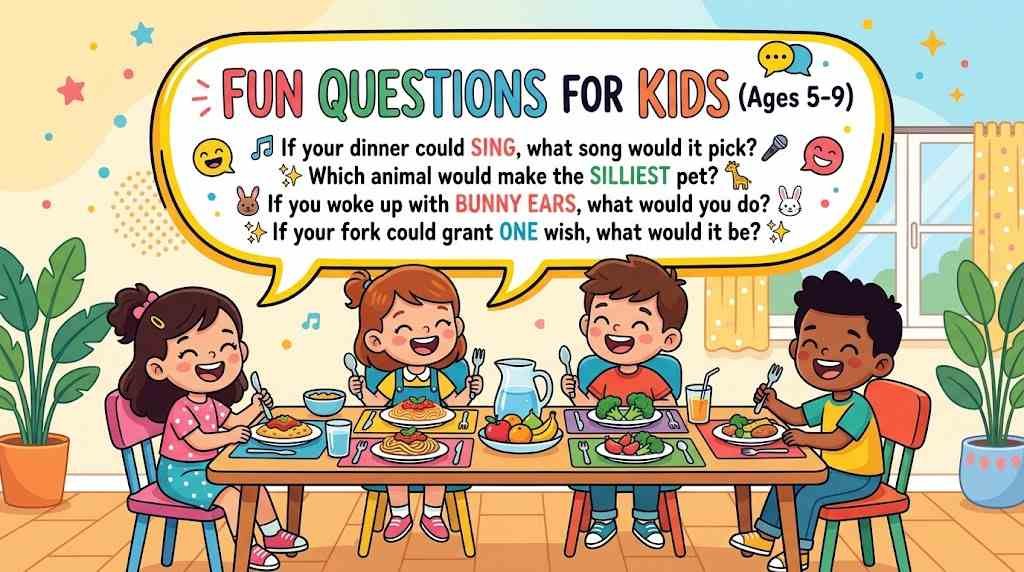
Quick Answer: The best fun questions for kids trade stressful interrogations (“How was school?”) for playful hypotheticals (“If your dinner started singing, what song would it pick?”). This lowers pressure and sparks real conversation at dinner, in the car, or at bedtime. Use our 100+ ideas and interactive wheel below to get started!
Why Traditional Questions Fail with Kids?
When a kid comes home from school or tuition and you ask a 6-year-old how was your day, the answer will be just a word that is good. Even if you ask a different question to a 7-year-old, like what you did at school today, the answer will remain the same: short and one word – nothing. Most parents think it is an emotional withdrawal or behavioural resistance. However, it is a cognitive bandwidth problem. When an adult asks the kid to summarise how the day was, they are asking the kid’s brain to execute four complex functioning tasks simultaneously:
- Chronological Retrieval: Look back 8 hours from school to get the moments.
- Emotional Categorisation: Divide which moment is bad or good to share.
- Social Translation: Remove the actions that adult may find foolish or scolding the kid.
- Linguistic Synthesis: Provide a polished narrative summary suitable for an adult listener.
After a long academic day at school, many kids don’t have energy to do this task; that’s why they just answer “Good” or “Nothing”.
| # | Dead-End Question | Why It Fails | Brain-Boosting Alternative | Expected Response Type |
|---|---|---|---|---|
| 1 | “How was school today?” | Triggers defensive, single-word answers (“Good”, “Fine”). | “What was the funniest thing your teacher said today?” | Specific visual memory narrative |
| 2 | “Did you make any friends?” | Creates performance anxiety or social pressure. | “Who made you smile during lunch or recess today?” | Low-pressure relationship highlight |
| 3 | “Did you eat your lunch?” | Feels like an interrogation or a chore audit. | “If you could trade one item from your lunchbox tomorrow, what would it be?” | Creative opinion & preference sharing |
| 4 | “Do you have homework?” | Instantly shifts energy from reconnection to stress. | “What was one weird or surprising fact you learned today?” | Curiosity-driven skill reflection |
The “Serve and Return” Alternative
According to the researchers of the Harvard Center, the developing child who grows up with healthy social and emotional skills relies on serve-and-return interactions, which are low-stakes conversational exchanges that work like a tennis game. Children cannot process adult conversation with a formal summary or self-reflection. They process it by imagination, play, and hypothetical scenarios.
When you let the children be a part of silly or creative conversation, you remove the demand for executive performance. A funny question will signal the safe, non-judgmental interaction and zero evaluation. The emotional connection flows naturally once the protecting wall drops.
The 3-Step Extension Framework
To make sure the playful prompts don’t just end after a 3-4 word answer, every single category in my guide uses a 3-Step Extension Framework:
Step 1: The Starter Prompt (Fun & Low-Stakes): It is an imaginative entry point where the defence is low and children easily participate.
Step 2: The Follow-Up Twist (Cognitive Expansion): This encourages problem-solving, lateral thinking and narrative design.
Step 3: The Connection Bridge (Emotional Grounding): This one includes a grounded question that links the scenario with real life and feelings of a child.

Section 1: Dinner Table Resets (Focus & Grounding)
The dinner table can be chaotic when the kids transit from a high-energy afternoon into a low-energy seated environment, leading to short attention and even silence on the table. These questions are designed to settle hyperactive nervous systems and increase focus on family meals.
The 3-Step Extension Script
- Starter: “If your dinner suddenly started singing right now, what song would it pick?”
- The Twist: “If we tried to eat it while it was singing, would it get mad or start laughing?”
- Real Connect: “What is one sound or song that made you feel really happy or made you laugh today?”
Ages 5–6 (Sensory & Concrete) Questions
- If your fork could talk, what would be the #1 rule it would make for our table?
- If you sneezed glitter every time you said “potato,” would you say it more or less?
- What is the worst pizza topping that should be banned from the planet for all time?
- What if our table turned into a boat right now and we sailed out to…
- If you had to eat only one color of food for a week, what color would you eat?
- What does your water glass think of you when you drop heavy ice cubes in it?
- If you had to swap your dinner for an animal’s dinner, which would you choose?
Ages 7–9 (Logical & Creative) Questions
- If you created a brand new vegetable, what would it taste like, and what would you name it?
- If you had a remote control that could pause anybody at this table, who would you pause first?
- What are your shoes under the table complaining about right now?
- What food did you hate that you can now tolerate or even enjoy?
- If our family started a food truck tomorrow, what would we sell and what would our team name be?
- If you ran a restaurant where kids were the bosses, what would be the single main dish on the menu?
- If you could establish one rule that adults had to follow at dinner, what would it be?

Section 2: Car Rides & Traffic Jams (Quick-Fire & Travel)
Car rides come with an advantage, like there is no face-to-face eye contact, and sitting side by side also reduces pressure, making the child feel low pressure and confident, especially if they are between 7 and 9 years old.
The 3-Step Extension Script
- Starter: “If you could swap our car wheels for anything else, what would make the ride smoother?”
- The Twist: “How would we bring the car to a complete stop if we were rolling on giant marshmallows?”
- Real Connect: “Where is your favorite place we’ve ever driven together as a family?”
Ages 5–6 (Wild Scenarios)
- Where would we steer this car if it could fly, but only as high as the treetops?
- If you looked out your window and saw a dog walking a giraffe, what would you say to them?
- What animal would you choose to replace our car horn with if you could?
- If you had a squirrel jump in your backpack right now would you tell me?
- If you could ride to school on the back of any creature, extinct or alive, which one would you pick?
- If the traffic light turned bright purple, what brand-new rule would drivers have to obey?
- If you could shrink this car down to the size of a matchbox, where would we hide it?
Ages 7–9 (Strategy & Subversion)
- If you could trade places with anyone in the car for a week, who would it be and why?
- Anything outside your window today that you think I missed while I was driving?
- What are we packing if we were stuck in this car for 24 hours and could only take three items from home?
- If you could hit a button and change the scenery outside to any movie world, which one are we driving through?
- If you had to invent a brand-new road sign, what shape would it be, and what would it warn drivers about?
- If you were hired to design a custom highway, what wild features would you build into it?
- If you could teleport this car directly to any building in the world right now, where would we land?
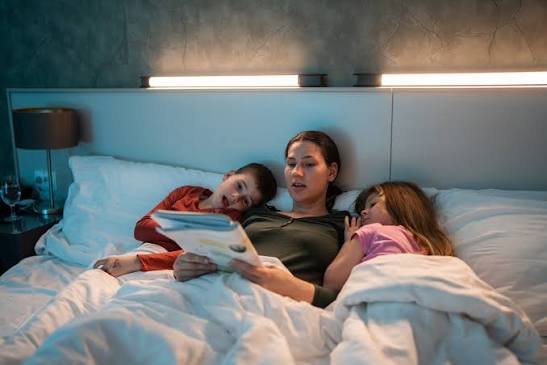
Section 3: Bedtime Wind-Down (Imaginative & Gentle)
When the bedtime is near, the children’s sensory environment gets cool down. The high-energy hypothetical needs to be replaced by low-stimulation or introspective questions that help to reduce anxiety and relax the brain.
The 3-Step Extension Script
- Starter: “If your pillow could grant one wish, but only at midnight, what would you whisper to it?”
- The Twist: “What would happen if the pillow misunderstood your wish and made it slightly silly?”
- Real Connect: “What was the cosiest or most peaceful part of your whole day today?”
Ages 5–6 (Comfort & Whimsy)
- What would your favorite stuffed animal do if it came alive for five minutes after you fell asleep?
- If you were to make a secret fort in your bedroom closet, what cozy things would you put inside?
- When dogs or cats twitch their paws in their sleep, what do you think they dream of?
- If you could turn your bed into any kind of floating vehicle, where would you float tonight?
- What do you call a friendly baby penguin at the foot of your bed?
- What is your favorite sound in the whole world to listen to right before drifting off to sleep?
- If you could paint the night sky any color besides dark blue or black, what color feels sleepiest?
Ages 7–9 (Internal World & Reflection)
- What would you say in a one sentence letter to yourself 5 years from now?
- If you found a secret door behind your bookshelf, what kind of world would you want to find?
- What did you do today that made you feel proud of yourself, even if no one else noticed it?
- If you had a magic backpack that carried memories instead of books, what memory from today would you put in?
- If you could choose any age to stay at for a whole year, which age feels best right now?
- What is a question about space, time, or the ocean that popped into your head today?
- If you could design a pleasant dream for tonight like a movie, who gets cast as the main characters?

Section 4: Superpowers & Hypotheticals (Inventors & Builders)
This category especially targets abstract reasoning, cause-and-effect evaluation, and lateral thinking, which works perfectly for kids that are between 5 and 9 because they master how rules work.
The 3-Step Extension Script
- Starter: “If you could pause time for 10 minutes every day, when during the day would you use it?”
- The Twist: “What is the one thing you’d be terrified of accidentally unpausing too soon?”
- Real Connect: “When during the week do you wish things would slow down so you aren’t rushed?”
Ages 5–6 (Body & Motion)
- If you woke up tomorrow with bunny ears what’s the first thing you’d do?
- If you could fly, but only as fast as a person walks, where would you fly to?
- If you could make your shadow come to life and do 2 of your daily tasks what would you have it do?
- Where would you explore in our house if you could shrink down to the size of an ant for an hour?
- If you could make everything you touched into chocolate , what would you not touch?
- If you could talk to one species of animal, which one do you think would have the funniest answers?
- If you had a magic wand that only worked once a week, what day would you save its charge for?
Ages 7–9 (System & Rule Design)
- What would be the superpower you discovered that you had that no hero ever had in any comic book?
- If you could control the weather for exactly an hour, what ridiculous weather phenomenon would you cause?
- What are the three main rules if you have to design a brand-new sport from scratch?
- If you could read minds only for one day, whose mind would you peek into first?
- What specific chore would you like a working robot to remove if you could build it with spare parts?
- If you could time travel, would you travel backward to see history or forward to see the future?
- If you could invent a brand-new color that no human has ever seen, how would you describe it?

Section 5: Animals & Creatures (Guaranteed Engagement)
Animal names work as a universal communication bridge. They let the kids project their personal feelings, observations, and concerns with the help of external subjects without getting exposed.
The 3-Step Extension Script
- Starter: “If a giraffe came over to our house for dinner, where would it sit?”
- The Twist: “How would we get the food up to its mouth without spilling everything?”
- Real Connect: “If you could bring any real animal to live with us for a day, which one would fit best?”
Ages 5–6 (Absurd Scenarios)
- If your pet (or a pet you want) learned to speak, what would be his/her first question to you?
- If you had to share your bedroom with an octopus, what would be the first thing you would change?
- So you wake up to find a little dragon sleeping in your drawer. What do you feed it for breakfast?
- If you could combine two animals to make a new animal, what would they be?
- What snacks are you bringing if you ride to the park on the back of a giant tortoise?
- If a parrot copied every single word you said today, what word would it repeat the most?
- If you found a glowing magic egg in the backyard, what kind of creature do you hope hatches?
Ages 7–9 (Ecology & Behavioral Imagination)
- If you managed the zoo for a day, what animal pen would you overhaul first?
- If animals could vote for a president of the forest, which animal would be elected?
- What do you think is the hardest thing about being a wild animal? Like a wolf or an eagle?
- Imagine you are living underwater with sea creatures. How would you build your house?
- What animal would you want to be to solve a mystery? 24 hours as any animal and you have an advantage.
- If dogs had their own social media or TV channels, what would the #1 trending video be?
- If you invited three animals to a formal tea party, which three have the best manners?

Section 6: Funny Confessions & “Have You Ever” (Story-Unlocking)
These types of questions help in creating emotional trust and safety. When you invite kids to share some funny or slightly awkward moments, you are actually creating a supportive environment where mistakes feel secure and normal.
The 3-Step Extension Script
- Starter: “Have you ever laughed so hard that milk or water almost came out of your nose?”
- The Twist: “What was the exact joke or silly moment that made you completely lose control?”
- Real Connect: “What is something funny that happened at school this week that you haven’t told me yet?”
Ages 5–6 (Playful & Physical)
- What is the silliest sound you can make with your mouth right now?
- You’ve been pretending to be fast asleep when you were really wide awake listening to us, haven’t you?”
- What was the most unusual place you ever hid in our house when we played?
- Ever attempt to make funny faces at yourself in the mirror when no one was around?
- What’s the funniest face you can make without saying anything?
- Have you ever dropped something behind a couch and just decided to leave it there forever?
- What is the funniest mistake you’ve made recently that made you laugh at yourself?
Ages 7–9 (Social Dynamics & Hidden Moments)
- Ever had a moment when you were supposed to be dead quiet but you burst out laughing?
- What’s a joke you told that completely bombed because no one got it?
- Have you ever faked understanding a word someone used just to keep the conversation moving?
- What do you do when you are all by yourself that makes you feel grown up?
- Have you ever found something you thought you lost forever in a weird place?
- What is the funniest thing you have ever seen a classmate or friend do by mistake?
- Have you ever invented an imaginary rule in a game so that you would not lose?

Section 7: Wild Wishes & Future Dreams (Values & Aspiration)
This category focuses on long-term goals, internal values, and family culture. These questions help the parents to understand what children’s actual fear, value, and hope are without feeling like an investigation.
The 3-Step Extension Script
- Starter: “If our family moved into any fictional world from a book or movie, where are we packing for?”
- The Twist: “What is the first thing we would have to adapt to so we don’t get lost?”
- Real Connect: “What is one thing about our real family life that you wouldn’t trade for any magic world?”
Ages 5–6 (Immediate Desires)
- What would you put in the extra room you could add to our house?
- If you could pick everybody’s clothes for tomorrow, what are we wearing out in?
- If you could have a wish but it couldn’t be for toys or money, what would you wish for?
- If you could swap places with any character from a series for one afternoon, who would it be?
- If you could invent a new family holiday, when would you celebrate it and what would you eat?
- So you wake up tomorrow and you’re suddenly the teacher of your class; what’s step one?
- If you were to plan our next family weekend and you had no limitations, what would we do?
Ages 7–9 (Abstract & World-Building)
- If you could make one official law for our house that everyone has to follow, what would it be?
- If you could spend a day with any person from world history, who are you hanging out with?
- Imagine you opened your bedroom door and it opened into another country. Where do you hope you are?
- What complex skill or instrument would you want to instantly master without ever having to practice?
- What one structural thing about how schools are designed would you change to make learning better?
- If you had to give our family an official superhero team name, what would it be?
- You have a whole day with no rules, chores, or schoolwork. What do you do with the first hour?
- If you were to design it, what features would be on a playground that was safe but felt super thrilling?
- What is one big project, building or creation, you want to complete by the end of the year?
Developmental Breakdown: Ages 5–6 vs. Ages 7–9
Ages 5 to 6 (Kindergarten to 1st Grade): Children of this age think in concrete, visual and on sensory terms. Their reasoning is centred on physical experience, and they process new things or ideas by magical realism, silly character roles and comedy, which means they don’t look for logic. They answer your questions concisely, are easily distracted and reply by adding animals, silly body modifications or immediate visual consequences.
- Parent Strategy: Keep your follow-up questions short and direct. Don’t force more questions or logic on this age of kids. Play with their silly scenes and rely on comedy or absurd visual details.
Ages 7 to 9 (2nd to 4th Grade): At this age, children come out from the imaginary world; they understand abstract concepts, logics, societal rules, and peer group dynamics. They care about competition, fairness and rules. They are capable of understanding difficult questions based on dry humour, sarcasm and strategic ones. You can challenge them with rule-based questions, design tasks and social hypotheticals. Give them time to explain the logic behind the answers.
Summary Checklist for Parents
- Don’t ask the kid how the day was and switch to play-based or low-stakes entry points.
- Save hard questions for car rides, walks, or cooking because in these situations there is less eye contact.
- If you ask the question and the child feels hesitant to answer, then you can give the wrong answer first to remove pressure on the kid.
- You can move from a Silly Starter to a Cognitive Twist, then land on a Connection Bridge.
- You can use a single question and let the kid answer it in 5 minutes; there’s no need to ask multiple questions at a time.
Frequently Asked Questions (FAQs) on Fun Question for kids
Q1: What should I do if my child still answers “I don’t know” to these prompts?
I don’t know coming from kids always means they are either facing cognitive fatigue or feeling put in the centre. The best strategy here is to remove the pressure from them by answering first. You can say, ‘That’s okay!’ If you asked me, I’d say… and give a funny incorrect answer. Once the child becomes confident and finds an adult has a playful response without any judgement, their hesitation phase drops, and they will try to correct you on the answer you give.
Q2: How do I transition my child from a silly hypothetical to talking about their real day?
You can use a 3-step extension framework also called the connection bridge. The main thing is to find the emotional or functional link in fantasy and real life, like if you begin with a silly prompt on car wheel replacing with giant marshmallows, you can connect it with real life by saying, ‘What was the most soothing or comfortable part of your day today?’ This silly question will open the door; the bridge grounds the conversation.
Q3: Why do my child’s answers seem shorter or less engaged on some days than others?
The conversation capacity of a child can fluctuate based on sensory overload, hunger, emotional stress, and physical fatigue. On some days they have heavy academic pressure, so they can’t be able to enjoy fun questions or responses in a good mood. If your child gives a long answer to a fun question, it means they have low energy, so make sure not to play funny questions for kids on hectic days.
Q4: Are these prompts suitable for children with ADHD or sensory processing differences?
Yes, but they can only get benefits by some common adjustments. Neurodivergent children thrive with these questions because the hypothetical imagination removes the linear chronological recall demands. If a kid has ADHD, you can use these questions while pacing during a walk, playing with clay, or driving. Keep the main focus on specific sensory or imaginative detail at a time so there is no overloading.
Q5: How many prompts should I use in a single conversation?
Remember, quality always beats quantity, which means you don’t need to ask 5 to 10 questions to a kid in a single day. Only ask one main question in a day and let the kid answer it in a day or minutes, whatever you prefer. A single meaningful 3-minute question/answer exchange builds more verbal confidence than a rapid-fire Q&A session.
Q6: How do these prompts help build emotional intelligence (EQ) in children?
Imaginative questions make a safe and indirect space for kids to process the real emotions. When children talk about why fishes are in aquariums and why zookeepers treat the animals badly, they are practising perspective-taking, empathy, and environmental problem-solving. These direct question exercises will build cognitive pathways needed for self-awareness and emotional availability in daily life.
Q7: My 8-year-old thinks silly questions are “babyish”. How should I adapt them?
If your 8-year-old thinks silly questions are childish, then you can shift from silly ones to system design, rules, and strategy. Children who are 7 to 9 years old develop concrete operational logic and are interested in fairness. You can ask, “If you had to design a 3-rule system for a kid-run restaurant, how would you keep it from turning into complete chaos?” Type questions.
Q8: Can I use these prompts with siblings of different ages at the same time?
Yes, you can use these questions on different ages of kids. A great strategy is to say the main scenario for everyone, then tailor the follow-up twist. You can ask sensory and visual questions to small kids and a strategic or logical question to older ones.
Q9: What is the best time of day to start using these conversation starters?
The best time is based on the kids’ mood in the day, but car rides and bedtime are the most effective ones. Car rides work with questions because there is side-by-side seating instead of direct eye contact, which builds pressure. Bedtime works because the sensory input slows down, making the kid naturally pay attention to storytelling.
Q10: How can I tell if these prompts are actually improving my relationship with my child?
You don’t get a sudden dramatic change overnight, so look for subtle shifts in conversational initiative. You will know if the framework worked when the kid starts bringing up their own questions, like, ‘Hey Dad, what if our house was made of glass? ‘Or when they start sharing how the school was today without even being asked.
Question Selection Guide for Parents
To select the best question for kids without searching the anything to match the situation you are in. Use the following chart.
| # | Context / Situation | Recommended Section | Goal & Psychological Effect |
|---|---|---|---|
| 1 | At the Dinner Table | Section 1: Focus & Grounding | Transitions kids from chaotic play to sitting quietly; settles hyperactive energy and redirects focus to the meal. |
| 2 | Car Rides & Travel | Section 2: Travel & Quick-Fire | Takes advantage of side-by-side seating without eye contact; lowers social pressure to encourage spontaneous sharing. |
| 3 | At Bedtime | Section 3: Gentle & Imaginative | Reduces sensory arousal and soothingly transitions the brain toward restful sleep. |
| 4 | Crafts & Unstructured Play | Section 4: Inventors & Builders | Stimulates problem-solving, cause-and-effect reasoning, and lateral thinking while hands are busy. |
| 5 | Walks & Outdoor Trips | Section 5: Ecology & Imagination | Builds emotional empathy, perspective-taking, and active observation of nature and animals. |
| 6 | Weekends & Family Gatherings | Section 6: Trust-Building | Uses light humor and funny confessions to normalize mistakes, reduce pressure, and build trust. |
| 7 | One-on-One Time & Planning | Section 7: Aspiration & Values | Gives children agency, uncovers their long-term interests, and strengthens family identity. |
